With the winter storm season approaching in Bellingham, WA, you might wonder how to keep your home’s electric system functioning. A whole-house generator is one way to do the job, but is it the right choice? Here’s a look at why to consider backup power in Bellingham, what the main options are, and how to choose the right setup.
Why Bellingham Homes Need Backup Power
The Bellingham storm season stretches from November through February. Storms in this region bring everything from heavy rain and snow to high winds. Unsurprisingly, this leads to downed trees and power lines, which often cause blackouts. Many rural and suburban areas can experience power loss for 12 to 48 hours after a major storm.
Protecting Home Systems
Backup power protects a wide range of home systems. For example, many houses in this part of the country need sump pumps to prevent basement flooding. Keeping the power on is critical to keeping the sump pump working.
Cold weather, especially in high-altitude areas, can freeze pipes. A backup generator is a great way to keep your home’s heating system working. This warms pipes and reduces the odds of damage from burst pipes.
Some households have essential medical equipment. If you or a loved one relies on these devices, you don’t want to risk losing power for any length of time.
Individuals who work from home also benefit from backup power. Keeping modems, phones, laptops, and desktops running is critical to maintaining a work-from-home environment during a power outage.
Whole-Home vs. Portable Generators
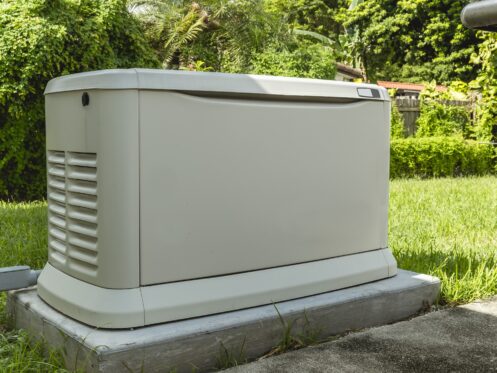
There are two main solutions for generating power during an outage. You can use a whole-house generator that connects to your home’s entire electrical system. Conversely, you can use a portable generator to protect key systems. Also, some homeowners use battery backup systems to store a certain amount of power or to bridge the time between an outage and when the generator kicks on.
Whole-Home Generators
The biggest benefit of a typical whole-home generator is that it comes on automatically once it detects a power outage. To be on the safe side, most whole-house systems wait about 30 seconds before turning on. This assures that the outage wasn’t simply a brief disruption.
Common whole-home generators provide 7 to 22 kW of power. A 22-kW system will provide enough power for most systems except very large or power-hungry houses. Conversely, a 7-kW design is more suited to powering essential systems like your HVAC system, refrigeration, lights, and a few amenities.
Portable Generator Options
A portable generator is useful in some situations. However, many models lack the necessary power to support a whole home. Typical models deliver 3 to 10 KW. They also usually use an extension cord to connect to devices. Notably, this may require retrofitting an HVAC to run on the power cord.
Placement is a huge issue with portable generators. If you’re not careful, a portable generator can exhaust dangerous carbon monoxide gas into your home. They also use a gasoline fuel tank, and you may need to top off the fuel to keep it running.
How to Choose the Right Generator Size
Calculating your household’s peak concurrent electrical load is the key to selecting the right size of generator. Some common wattage figures for standard home systems include:
- Furnace, 1,500W
- Well pump, 2,000W
- Refrigerator, 800W
- Sump pump, 1,200W
- Lights, 800W
- Electronics, 500W
Include a few amenities, like a microwave and electric oven, and it’s easy to see why many homeowners opt for a larger-capacity generator. It is also important to have some general overhead. We recommend at least 20% overhead beyond your worst expected use case.
Professional Installation & Maintenance Tips
Proper installation is critical for safe operation. Our team can help you find the right way to integrate a whole-house generator with your home’s electrical panel. We offer generator installation in Bellingham, WA and any nearby community.
A home generator in Bellingham requires some periodic maintenance. This includes replacing the filter and changing the oil regularly. Generally, you can perform these tasks once a year before winter sets in. However, an earlier oil change will be necessary if the system has operated for more than 100 hours since its last oil change.
Marr’s Heating, AC, Plumbing and Electrical offers a variety of electrical services to residents and businesses in Bellingham and the surrounding areas. We offer 24/7 emergency services. The community trusts us because we have been around since 1965. Our extensive experience and positive reputation show our dedication to high-quality service. If you wish to install or update a whole-house generator for your Bellingham residence, contact Marr’s Heating, AC, Plumbing and Electrical today.